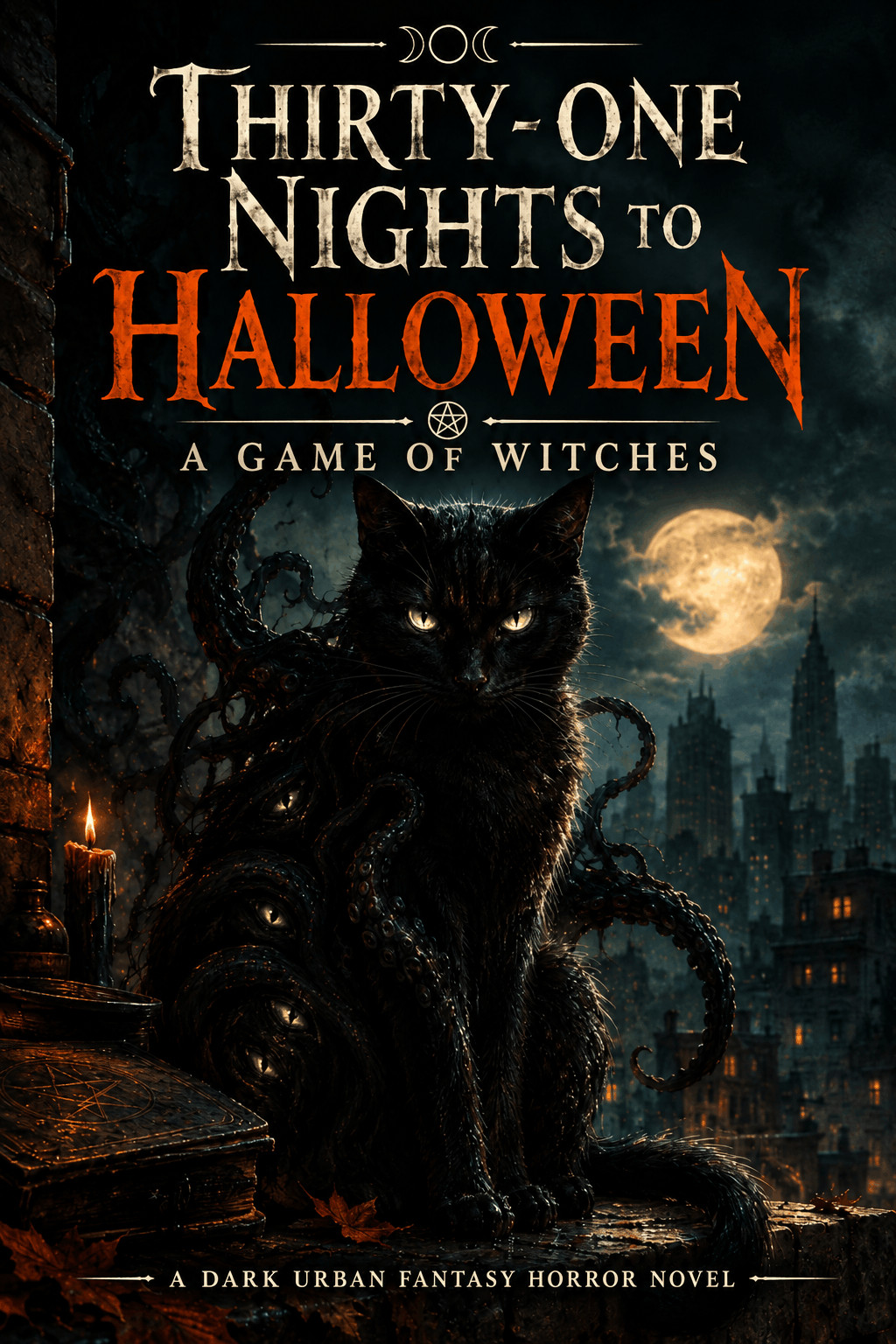
Thirty-One Nights to Halloween: A Game of Witches
A Dark Urban Fantasy Horror Novel
Chapter 1
by  Megaera
“This is not a dream. You are not going insane.”
From anyone else, it might have been reassuring. From his dead father’s cat, it was something else entirely.
Eli Calloway lay very still under the blankets of the narrow bed he had slept in through twelve years of childhood and a few vacations after and stared at the animal sitting at the foot of it. Gray morning light leaked around the curtains. The cat’s tail was curled neatly over its paws, and its amber eyes were fixed on him with the patience of something that had been waiting a long while.
Eli was eighteen, a senior in high school, and until a few weeks ago he would have called himself an ordinary kid. Decent grades. A handful of friends. A mother who worried too much and a father he saw a couple of times a year when the holidays allowed it. Nothing in that life had prepared him to wake up in a dead man’s house and be spoken to by the dead man’s pet.
“This has to be a dream,” he said. His voice came out thin and cracked. He had barely slept since the phone call, and he knew what grief and exhaustion could do to a mind. He had read about it. People saw their dead in doorways. People heard voices in empty rooms. He pressed the heel of his hand against one eye and prayed for the dream, because the alternative was the one with doctors in it. “Or I’m losing it. Cats don’t talk.”
The cat let out a short, dry snort with no humor in it.
“If it makes you feel any better,” Mordecai said, “I’m not really a cat.”
Eli knew this animal. Everyone who had ever set foot in this house knew him: sleek and black, with a white left forepaw, a torn right ear that had been torn for as long as Eli could remember, and eyes the color of weak tea held up to a lamp. Mordecai had been asleep on the radiator in Eli’s earliest memories. He was in the photographs from Eli’s third birthday. He was in the photograph from last year’s Christmas card, the one his father had mailed with a note that said Thought you might want a picture of the old man. The old man had meant the cat.
“Think about it,” Mordecai said. “You’re eighteen, and I’ve looked exactly like this the entire time you’ve known me. Housecats don’t live that long, and they definitely age. You never wondered?”
“I thought you were just...” Eli began, and found he had nothing to put at the end of it. “I thought you were lucky.”
“I was summoned,” Mordecai said. “A long time ago, your father called me to be his familiar. This is the shape I took.”
“Familiar,” Eli repeated, slowly, the way you test a word in a language you barely speak.
He knew it, in the patchy way he knew a lot of things. From a game he had played too many hours of. From a unit on the witch trials that his eleventh-grade history teacher had rushed through. Witches kept spirits that helped them, imps wearing the shapes of toads and cats and hares, and the old records were full of confessions about what those spirits had done. It had all seemed like superstition, the kind of story frightened people told to explain their neighbors.
“The popular imagination got the cats right and everything else wrong,” Mordecai said, as if he had been reading over Eli’s shoulder.
“So you’re saying...”
“I’m saying your father was a witch.” The cat’s voice was low and weary, with a lot of mileage on it. “An experienced one, and a very good one. The Calloways are an old family. Centuries old, from back when the name was spelled differently. This year, your father was supposed to be their champion.”
Eli sat up. His left palm itched, a small, sharp itch right at the center, and he rubbed it against the blanket without thinking. “Champion of what?”
“The contest.”
“I need you to start further back than that.”
“You’ll want proof first,” Mordecai said. He rose, stretched, and walked up the length of the mattress to settle near Eli’s knee. “I’d rather you didn’t spend the morning thinking I’m a symptom of a mental breakdown.”
On the dresser, between a third-place science fair trophy and a cracked snow globe, sat a stub of blue candle, the last survivor of Eli’s twelfth birthday cake. Mordecai glanced at it. The wick stood up and caught fire, with no match and no sound, and a thread of smoke curled toward the ceiling.
Eli did not scream. He stopped breathing for a few seconds, then started again, shallow and fast, with the smell of burning wax in his nose.
“Okay,” he said. His hands were shaking, and he pressed them flat against the blanket. Hallucinations were supposed to be vague at the edges. This had a smell. This had weight. “Okay. You’re not a cat. What are you?”
“That’s a longer conversation. One impossible thing at a time.” Mordecai gave him a moment. “Do you want to hear about the contest?”
Port Verity was still asleep outside the window. Eli could see a slice of it past the edge of the curtain, the way you could see it from nearly everywhere in town: the harbor fogbound and pewter-colored, the long arms of the cranes standing idle over the docks, the old cannery with its windows gone black. A rust-belt city of shuttered factories and cemeteries older than the state. He had been born here. He had learned to ride a bike on this street. When his parents divorced, he and his mother had left for a city four hours inland with whatever fit in her hatchback, and Port Verity had become a place he saw mostly in memory.
Until yesterday, and his father’s funeral. A gray sky, a gray suit, a hole in the ground. His mother had not come. She had begged him not to go, and when that failed she had tried to talk him out of it. Something about the Calloway family had always frightened her, though she had never been able to say what or prove any of it, and she could hardly keep a son from his own father’s funeral. Eli was eighteen, and an adult now, and she knew that too. So he had taken the bus alone, four hours of gray highway, and walked the last mile from the station with a duffel over his shoulder. She had driven him to the station and stood on the platform with her arms folded, and when he told her he wanted to stay a few days to go through his father’s things, she had given in with the expression she wore when she was losing an argument and knew it. For years he had assumed she wanted to keep him away from Port Verity out of resentment over the divorce. He was only beginning to understand that it was love, and fear: she wanted him safe from whatever dark thing she had come to suspect about the Calloways and this town. It came out of her as control, and he could not hold that against her. A week, she had said. Then I’m coming to get you.
“Every eighteen years,” Mordecai said, “a contest is held in Port Verity. Thirteen witches from thirteen clans, one champion each. It began today. It will run until midnight on the thirty-first, All Hallows’ Eve, and the last champion standing gets a wish from the Great Old Ones who stand behind the whole affair. A real wish. Whatever you can word carefully enough to survive getting it.”
Eli let out a breath that did not quite become a laugh. “That’s a lot to take in.”
“I know. I would give you a week to take it in, if we had one.” The cat said it gently, which somehow made it worse. “We don’t. Every clan wants that wish. Every champion is a seasoned witch with years of training, and each one has a familiar like me, bound to assist them. Each one has a patron, a power that grants favors in return for service. The contest is often deadly, Eli. People die in it. Not by accident.”
The cold arrived before the understanding did. Eli looked at the cat. “Dad died in a car accident.”
Mordecai did not look away. He did not, Eli noticed, say yes.
“Your father drove the coast road for twenty years,” the cat said quietly. “He knew every curve of it. He always told me to come along when he went somewhere that mattered. That night, for the first time since I have known him, he told me to stay home.” The amber eyes held steady, but something moved behind them that was grief, or the closest thing to grief that a creature like him could wear. “He was the strongest witch the Calloways had put forward in a generation. He was the favorite to win. The contest was not officially open yet, but someone who wanted better odds, and was not particular about how to get them, could have decided to remove him early. Your father was murdered, Eli. I can’t prove it, and I don’t know who did it. But I am certain of that much.”
The room was very quiet. Somewhere down the hall, an old pipe ticked as the house warmed.
Eli thought about his father. Thomas Calloway, forty-seven years old: tall, bearded, weathered by whatever he did with his days, with thick fingers that were always stained with ink. A man of few words and long silences, though he had not always been. For the first twelve years of Eli’s life he had been a good father, patient and present, the one who ran behind a bicycle on this very street with a hand on the seat until Eli looked back and found he was riding alone. They had been close. Somewhere after the divorce a distance had opened between them, a little at a time, and Eli had never found the right thing to say across it, and mostly he had stopped trying. He thought about the text that had arrived on his eighteenth birthday, a day late, the way everything from his father arrived. Happy birthday, kid. Eighteen. Call me when you get a chance. There’s something I need to tell you. He had answered with a single word. thx. He had meant to call. He had been busy, and a little angry, and certain there was time.
There had not been time. And someone had taken what was left of it.
His grief had been a slow gray weight for days, the kind that settles and stays. Now it shifted into something with an edge. It was not lighter. But it had somewhere to point.
“What would I have to do?” he heard himself ask.
Mordecai looked at him. “I’m sorry?”
“If I wanted to find out who did it. What would I have to do?”
“You could walk away,” the cat said, which Eli had not expected. “I would be lying if I told you that was a bad idea. A champion can forfeit. There is a host, and you surrender your mark to him, and you go home alive, with no magic and no part in any of it. Some call that cowardice. I call it survival.”
“And whoever killed my father gets to win.”
“Possibly.”
“Then no.” Eli swung his legs out of the bed. The floorboards were cold under his feet. “If he was supposed to do this, I’ll do it. I’ll learn whatever I have to. I’m eighteen. Apparently that’s old enough.”
“That is exactly why it falls to you.” Mordecai watched him, and for the first time something almost like warmth crossed the small, hard face. “You turned eighteen last month. That makes you an adult in the eyes of the clan, and a witch in the eyes of the blood. Witch is a gender-neutral term, by the way. And you are Thomas Calloway’s son. The seat your father held is Number Thirteen. His patron, Bast, left it empty when he died, and the mark follows blood. It claimed you the moment you came back to town for the funeral.”
Eli looked at his left palm. Nothing showed on it, no scar, no brand, only the faint itch that had not quite gone away. “The mark.”
“It will come. The host will make it formal, and when he does, a sigil will rise on your palm, a brand with a number in it, like a mark of ownership. It stays until the contest is over, and it burns when another champion is near.” Mordecai paused. “For now, you have been counted.”
“That’s insane,” Eli said, but there was no force in it. A few minutes ago he had watched a candle light itself, and he could hear how hollow the word sounded. “I just agreed to all of this, didn’t I?”
“You did,” Mordecai said. There was no mockery in it, only a tired sort of respect. “I expected this to be harder. A talking cat, magic, a contest to the death. I thought I would be arguing with you for days.”
Eli rubbed the back of his neck, the old nervous habit, and found the muscles there knotted like rope. “I already lost him. If there’s something I can do about it, I can’t go home and sit in my mother’s living room pretending I didn’t hear you.”
“No,” Mordecai said, softer now. “You have the Calloway blood in you. Your father would have said the same.”
Eli did not know if that was true. It was a strange thing to be told by someone who might have known his father better than anyone alive. He tucked the thought away carefully, where it couldn’t be broken.
Eli was quiet for a moment. Then he said, “Bast.” He turned the name over. “The Egyptian cat goddess? That Bast?”
“That is the name your father used.”
“She’s real?” It came out sharper than he meant. A goddess from a museum case and a school textbook, from a hundred gift-shop statues of a woman with a cat’s head. “People still worship her?”
“Not the way your textbooks mean it, and she is not real the way you and I are real.” Mordecai seemed to weigh the question with care. “Patrons are far older than the names people gave them. The Egyptians looked at something vast and watchful and protective, and they called it Bast, and it answered to the name. Before that it had no name at all. When the pyramids are dust, it will have another. What a witch bargains with is not a statue or a story. It is the thing underneath.”
Eli looked at the black cat on his bed, sleek and unblinking. “And you’re a cat.”
“I am.”
“My father’s patron was a cat goddess, and you took the form of a cat.” He shook his head slowly. “That can’t be a coincidence.”
“I don’t believe in coincidences. I believe in things you haven’t looked into yet.” Mordecai let that sit. “Your father chose his patron well. But understand something, Eli. Yours may not be Bast. A patron doesn’t belong to a bloodline. It chooses whom it will answer, and some are older than she is. Older than writing, older than the sea. They are powerful, and most of them are not kind. Whatever you end up bargaining with, it will not be bargaining because it likes you.”
He stood. “Who runs the clan?” he asked. “If it’s old, someone has to. Somebody decided Dad was the champion.”
“A matriarch.” Mordecai hesitated, which was unusual enough that Eli noticed. “Ophelia Hale. She married into the Calloway name and, over fifty years, made the two families into one clan, with herself at the head of it. She is your father’s mother, Eli. Your grandmother.”
Eli stared at him. He had met his grandmother perhaps four or five times in his life. He remembered a tall woman in an expensive coat, a smell of something like roses and cold stone, and expensive gifts, or sometimes just a check, that arrived on his birthday in thick cream paper. His mother had never liked Ophelia, and Eli was fairly sure the feeling was mutual. She had never forgiven the woman’s contempt, or the way she tried to control every corner of her son’s life and expected obedience in return. She put the gifts away unopened, and the money went into his college fund. He remembered, now, the funeral: a silver-streaked woman at the far edge of the graveside, with a car and a driver waiting behind her, who had not cried. He had noticed that because everyone else had. When the service ended she had rested a gloved hand against his cheek and said, We will talk soon, Elias. He had thought, even then, that his mother would have gone rigid if she had been there to see it.
“Does Mom know?” Eli asked. “About any of this?”
“Not the way you mean. She was never told, and I doubt she would have believed it. But she suspected. She lived in this house for years, and she is not a fool. She saw enough to know that something about this family frightened her, and she left before she could learn what. Your grandmother never forgave your father for marrying outside the clan without her leave.” Mordecai’s tail flicked once. “That is why she did not want you here. Your grandmother has sent word that she wants to see you. Dinner, Saturday. It was not phrased as a request.”
Eli said nothing. After a moment, he went to the door.
The stairs creaked in all the same places. That was the first thing that undid him a little. Three years gone, and the seventh step still complained. The house smelled of dust, old books, and something he thought was the ghost of his father’s pipe tobacco, a smell Eli had not known he remembered until it hit him in the chest.
There was a light on in the kitchen, and someone sat in it.
He had met her only once, at the funeral, for about thirty seconds at the edge of the crowd. Her eyes had been swollen and red, and she had said You must be Eli, and then, so quietly he almost missed it, that she was sorry about his dad. She had slipped away before he could answer. He had known his father had a girlfriend, but he had never met her. Between twelve and fifteen he had come back to this house for some of his vacations, and then, three years ago, his father had started making excuses. They had met for dinners in other places, and Thomas had driven to the city to see him, but Eli was never invited back to the house. After the divorce he had decided his father simply cared less, that the man had let him go, and he had been curt with him ever since. Now he wondered. Vex had already moved in by then, and something else had been happening in these rooms: rituals, preparations for the contest, whatever else a witch did behind closed doors. Maybe the distance had never been neglect. Maybe it had been his father’s way of keeping him out of all this, of keeping him safe. And Eli had come back anyway, for the funeral, and walked straight into it.
Vesper Lindqvist, whom everyone called Vex, sat on the counter with one bare foot braced against a drawer and a mug held in both hands. Eli had only learned from the whispering at the funeral that she was twenty-one, three years older than he was. He had pictured his father’s girlfriend as a woman his father’s age, or maybe a little younger, not a girl barely out of high school. The knowledge had turned his stomach then, and it did again now: she had been eighteen when she moved in, a girl who could have sat beside him in homeroom, and his father had been forty-four. Her hair was black and chopped unevenly, with streaks of red cutting through it. Heavy eyeliner, smudged at the corners. A pair of snakebite piercings in her lower lip, a tiny stud in her nose, a thin black choker. Striped arm warmers, black and gray, and a faded band tee that hung off one shoulder. At the funeral she had worn black like everyone else, though the hair and the piercings had still stood out. Here, at home, she had gone back to her own clothes. She was also, he had to admit, strikingly pretty, in a way that had nothing to do with anyone he had gone to school with. He had always thought of the look, the eyeliner and arm warmers and band shirts, as something other people did. Seeing it on her, he was beginning to understand the appeal, and the first coherent thought he had was that he was a terrible person for noticing.
She was his father’s girlfriend. His dead father’s girlfriend. He looked at the floor.
“You look like hell,” Vex said, not unkindly. “Do you want breakfast?” She tilted her head at the open cabinet beside her.
The shelves held two lives. On one side sat Raisin Bran, plain shredded wheat, and a box of something advertising heart health, the cereal of a man of forty-seven, at the age when you start listening to your doctor. On the other, shoved into the corner, were Lucky Charms and Froot Loops and a box of cocoa something, bought by a twenty-one-year-old who saw no reason to give up the cereals she had grown up on.
“Half of it was his and half of it is mine,” Vex said. “I don’t know what to do with his half.” She stopped. Her mouth tightened, and for a moment the whole kitchen went very still.
Eli took the Raisin Bran. It was what his father had eaten. He sat at the old table and ate it slowly, and it tasted like cardboard and raisins and nothing else, and he was grateful for that. Mordecai had followed him down and now sat on the windowsill, tail twitching, watching the street.
“So,” Vex said after a while, in the careful voice of someone who knew exactly what she was asking. “Has he done the talk yet?”
Eli’s spoon stopped. “The talk.”
“The contest. The clans. The champion.” She took a swallow of coffee. “He’s been working up to it since your dad died. I heard him in the living room last night, going over it to himself.”
“You know about this?”
“Eli.” She set the mug down and gave him a look that was not unkind, only very tired. “I’ve lived in a witch’s house for three years. I’m one too, in a way. Not like your father. He had decades on me. I’m an apprentice. I was his ritual partner. I held the candles. I helped him with everything. I learned things I wish I could unlearn, and a few I’m glad I know.” Her eyes were wet and bright, and she wiped them with the back of one striped wrist, as if the tears were an inconvenience. “Everything the cat told you is true. I’m sorry. I wish it weren’t.”
Eli stared at her. He had a hundred questions and no words for any of them. My father’s girlfriend is a witch. He said it again, aloud, because he needed to hear how it sounded. “You’re a witch.”
“Apprentice,” Vex said quietly. “But yes.”
On the sill, Mordecai did not turn his head. “She helped him more than he ever admitted,” he said. “She will help you, if you let her.”
Eli looked down at the bowl, the cereal going soft in the milk. Beyond the kitchen window, fog was lifting off the harbor in long, slow ropes, and somewhere across the water a ship’s horn gave a low, broken call. His left palm itched again, steady and sharp, as though something under the skin had begun to wake.
He had gone to bed last night a boy who had just buried his father. Somewhere in the hours since, that boy had stopped being the only thing he was. Thirty-one days of October stood ahead of him, and he did not yet know how many of them he would see.
What's next?
- No further chapters
- Add a new chapter
- Customize choices
0 comments
No comments yet
The story has no discussion yet. Leave a note here when a branch gives you something to say.
No chapter comments yet
No one has commented on this branch yet. Add the first note above.