
In the other place there is no weather.
That is the first thing the ones who live there forget to mention, on the rare nights they mention anything at all. No weather. No mornings. A sky the color of a bruise that never finishes forming, and a ground that gives a little underfoot, like packed ash that remembers being something warmer. They sit on the ridges and they watch the human world the way a man on a fire escape watches a street he has already walked a thousand times. Desire, spent. Desire, restocked. The same three hungers turning over in new bodies.
Vesh had been watching for a long time.
He was tall in the way a shadow is tall when the lamp is too low. Joints a little wrong. A mouth that looked borrowed. He kept a black notebook against his ribs the way some men keep a flask, and for a century or so he had used it the way it was meant to be used, which was not often and never with much imagination. The rules were old. The appetite they served was older. Lately even that had gone flat.
So he dropped the book.
Not as a gift. Not as a test with a name on it. He opened his hand over a city that still had nights in it, and he let the notebook fall, and he sat back on the ridge to see which kind of animal picked it up.
Philadelphia in late September still held the heat in the brick.
Reed Calder felt it through the soles of his shoes on the walk home from the Free Library, the good building on the Parkway with the lions and the tourists, though his actual work lived in the annex most people never saw. He had spent the last six hours opening donation boxes that smelled like attics and basement summers. Old National Geographics. Church cookbooks with grease ghosts on the pie pages. A complete set of somebody's law school highlights, yellow as a warning. His shoulders hurt in the specific way they always hurt on Thursdays, which was box day.
He was twenty-six. He looked older in the fluorescent light and younger on the sidewalk. Dark hair that he forgot to cut until his sister mentioned it. A mouth that stayed closed in photographs. He had a mechanical pencil behind his left ear even off the clock, because his hands liked having something to do, and he cracked the knuckle of his left thumb when he was thinking, which was most of the time.
South Philly rose around him in its usual layers. Mural paint. Window AC units dripping onto stoops. A corner store with the lottery machine glowing like a small cheap church. Somebody's radio from a third-floor window, Spanish, too far away to catch the words. Reed knew the route the way you know a scar. Library to Broad. Broad to the turn where the sidewalk buckled. Then the last four blocks where the street got quieter and the cats got bolder.
He was thinking about nothing in particular, which was a skill he had practiced since his mother died. You could let a whole city pass through you if you didn't grab at any one piece of it.
The notebook was sitting on the low wall beside the shuttered tailor shop on Passyunk, the one that had been "UNDER NEW MANAGEMENT" since spring and was still empty. Black cover. No sticker. No rubber band. It did not look forgotten so much as placed. The wall was dusty. The book was not.
Reed stopped because he was the kind of person who stopped for abandoned books.
He looked both ways out of habit, as if a book needed witnesses. A bus sighed at the light a block down. A woman with a grocery bag crossed against the don't-walk and did not glance at him. He picked the notebook up.
It was heavier than a composition book should have been, and faintly warm, like it had been in a pocket. The cover had two words on it in a thin, careful hand that was not quite English-class cursive and not quite print.
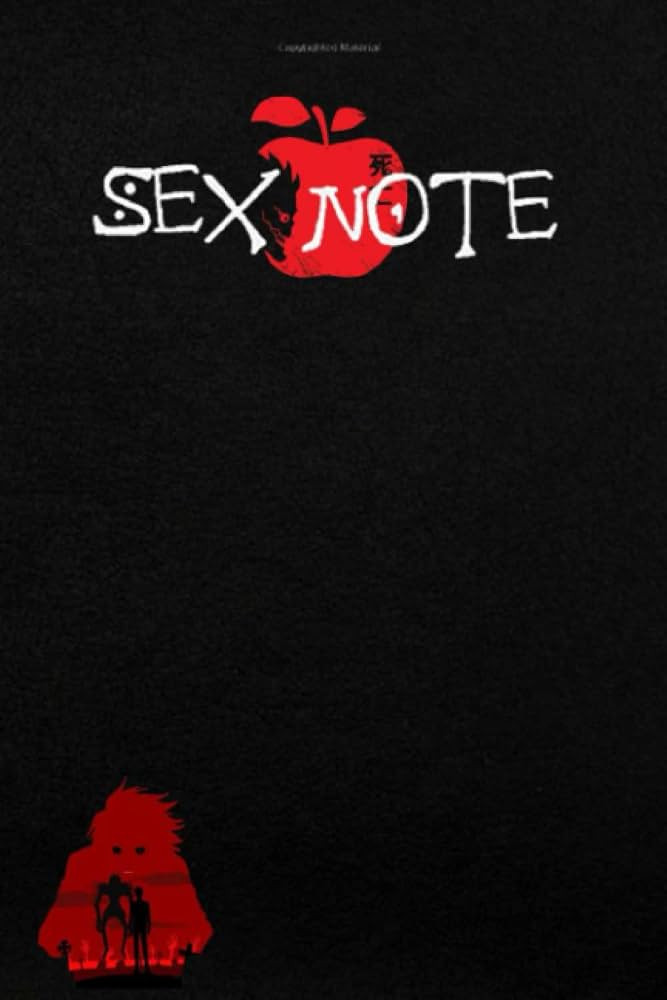
SEX NOTE
Reed almost put it back.
He turned it over. Blank back. No price. No library mark. No name inside the front, at first, only a page of rules written in that same thin hand, black ink that looked wet even though it wasn't.
He read standing there under the tailor's dark window, because reading was what he did when a thing made him uncomfortable.
The human whose name is written in this note shall be bound to the desire written therein.
This note will not take effect unless the writer has the person's face in their mind when writing his/her name. Therefore, people sharing the same name will not be affected.
If the nature of the desire is written within 40 seconds of writing the name, it will happen.
If the nature of the desire is not specified, the subject will be taken by a hunger for the writer, and will seek the writer out within one day.
After the nature of the desire is written, details may be added for 6 minutes and 40 seconds. Details may include the act, the hour, the place, the duration, the partner or partners, and what the subject remembers afterward.
The desire must be possible in a human body. This note will not kill. This note will not make a child. This note will not rewrite a life past the window that is written.
Once a name is written, it cannot be taken back.
Reed laughed once, under his breath, the way you laugh at a joke that is trying too hard.
Someone's art project. Someone's scene. A prop from a show at one of the warehouses off Washington, left on a wall because the bit was over. He had seen weirder things on this street. A full Thanksgiving dinner set for nobody. A single red heel standing upright in a planter. Philadelphia put its leftovers out and trusted the night to sort them.
He should have left it.
He put it in his bag between a half-finished Thermos and a paperback he was not enjoying, and he walked the last four blocks with the weight of it tapping his hip, and he told himself he was only taking it so some kid didn't find it and think the world worked like that.
His apartment was the second floor of a row house on a block that still had two old women who swept their stoops like it was a job. One bedroom. A kitchen that was really a hallway with a stove. The window over the sink looked into an airshaft and, beyond it, the rear windows of the building on the next street, close enough that Reed knew the woman directly across by the hours she kept and the color of her lamp.
Her name was not a mystery. Packages sat on her step with it printed in plain type. Lena Marsh. She was thirty, maybe. Dark hair she wore up when she cooked. She worked hours that were not library hours. Sometimes she sang, badly, with the window cracked. Reed had never spoken to her except the one time they both reached for the same dropped piece of junk mail in the vestibule and she had said all yours without smiling, and he had said thanks too late.
He set the notebook on the table and did not open it again until he had showered and eaten leftover rice standing up. The apartment smelled like dish soap and the ghost of the onion he had burned two nights ago. From the street, a car stereo passed through bass-first and was gone.
He sat.
The rules were still there. They had not become less ridiculous under a better bulb.
Reed turned pages. The rest of the book was empty. Cream paper, a little too nice, no college-rule lines, only a faint grain like laid stationery. He ran a thumb along the edge and felt nothing supernatural. Paper was paper. Ink was ink.
He thought about writing a name.
Not because he believed it. Because the instruction sat there like a dare written by a person who understood how dares worked. You put a rule on a blank page and a certain kind of mind will lean toward the page whether it wants to or not.
He knew names. That was the trouble with working where he worked. Library cards. Donor forms. The staff directory taped inside the break-room cabinet. Maya at circulation, who had a silver cap on one front tooth and a way of saying you're all set that made people leave happier than they arrived. Chris from Facilities, who hummed. His sister Claire in Collingswood, who would call tomorrow and ask if he had eaten a vegetable.
He closed the book.
He went to bed with it on the table like a guest he had not invited and was too polite to throw out.
Sleep came the way it usually came, late and thin. In it he was shelving a row of books that kept turning into other books, and someone at the far end of the aisle was saying his name as if they had been saying it for years.
Friday he almost left the notebook at home.
He stood in the doorway with his bag open and looked at it, black and ordinary in the morning light that made everything look less like a secret. Then he put it back in the bag, under the paperback, because leaving a thing like that on the table felt like leaving a window unlatched.
The annex was cold in the way old municipal buildings were cold, a stored chill that did not care what the sidewalk was doing. Reed worked the donated biographies until lunch. He ate a turkey sandwich that had gone sad in the break-room fridge and listened to two pages from Cataloging argue about a parking ticket. Maya came in for coffee and said the public computers were full of people printing résumés and one man watching a video of a hurricane with the sound on.
"You look like you slept in a bus station," she said, not unkindly.
"Box day hangover."
"Those aren't real."
"They are if you lift with your spine."
She smiled with the silver tooth and left. Reed sat another minute with the coffee cooling and thought about the rule that said a face and a name. He could see Maya's face without trying. He could see Lena Marsh's face from the airshaft, the way she stood at her sink with one hip cocked, scrolling her phone with a wet hand.
He did not write anything.
Belief, he decided on the walk to the bus, was not the danger. The danger was the part of him that wanted to know. That part had always been there. It had sat with him in hospital corridors. It had made him read the accident reports in the Inquirer all the way to the end. It was the same part that opened boxes other people taped shut.
He got home a little after seven. The block was in that in-between hour when the day-shifters were inside and the night people had not come out yet. He climbed the stairs. He set the bag down. He took the notebook out and laid it on the table the way you lay down a tool.
From the airshaft window he could see Lena's lamp already on, the warm one, not the overhead. She was not in view.
Reed sat. He uncapped a pen that was not the mechanical pencil. Ballpoint. Black. He looked at the first empty page for a long time.
The experiment, if he was going to be honest with himself, had already started the moment he carried the book off the wall. This was only the part with handwriting.
He needed a name he knew, a face he could hold, and an outcome he could see without walking into anyone's life. Something small. Something that would fail, and then he could put the book in the trash and stop thinking about the heat of it.
Daniel from the laundromat on 7th. Reed did not know him well. He knew the shape of him. Tall, mid-thirties, a gold chain he touched when he talked, always one machine over with a phone playing a podcast at a volume that assumed the room was his. Last week Reed had been folding a shirt and Daniel had said, to no one, people in this city don't look at each other anymore, and then he had looked at Reed as if waiting to be agreed with, and Reed had nodded because it was easier.
Reed had seen the name on a dryer cart sticker once, a faded strip of tape. D. Okonkwo. Then, later, on a piece of mail that had fallen out of a basket. Daniel Okonkwo. Faces and names. The city leaked them if you paid attention.
Reed pictured the man. The chain. The way he stood with his weight on one heel. He wrote, carefully, as if handwriting might be part of the trick:
Daniel Okonkwo
Forty seconds. He could feel them. He wrote faster.
At 8:42 tonight he will come out onto the stoop of the laundromat, look up at the sky, and say, out loud, I want someone to touch me like they mean it.
He sat back.
The sentence looked stupid on the page. It looked like a line from a play no one would stage. The clock on the microwave said 8:19.
Reed stared at the words until they stopped being words and became marks. Then he put the pen down, took his keys, and walked the three blocks to 7th because if he stayed in the apartment he would invent a reason not to look.
The laundromat was still open. It always was, until ten. Fluorescent light the color of weak milk. Two women folding. A dryer thumping like a bad heart. Daniel was there, as Reed had half-hoped and half-dreaded, in the plastic chair by the front window with his phone in both hands. The gold chain. The heel.
Reed did not go in. He stood across the street under the awning of a closed barber, close enough to see and far enough to be nobody. His pulse was doing something unhelpful in his throat. He cracked his left thumb knuckle and then made himself stop.
8:37.
Daniel laughed at something on the screen. One of the women said excuse me and reached past him for a basket. Ordinary. The city being the city.
8:40.
Reed thought, with a clarity that surprised him, if this works I will have done a thing to a person that he did not ask for. The thought did not arrive as morality. It arrived as fact, the way a shelf measurement arrived as fact. He had written a sentence into a stranger. That was the shape of it, whether the sentence came true or not.
8:42.
Daniel's head lifted.
It was not dramatic. He did not clutch his chest. He stood, the way a man stands when he has decided to get air, and he pushed the glass door with his shoulder and stepped out onto the stoop. September still in the brick. A bus going by. Daniel tipped his face up, not at a plane, not at anything, just up, and his mouth opened.
Reed was too far to hear it clean. Traffic took the consonants. But he saw the shape of the line. He saw the breath it took. He saw Daniel's hand go to the gold chain and stay there, and then Daniel laughed, once, sharp, like a man catching himself in a room with a mirror, and he went back inside and sat down as if he had never stood.
Reed walked home without noticing the blocks.
In the apartment he did not turn on the overhead. The airshaft lamp across the way was still lit. Lena's window empty. The notebook open on the table to the sentence in his own handwriting, black and small and finished.
He sat down hard enough that the chair complained.
There were explanations. Coincidence. A man stepping out for air at a round number. A sentence Reed had wanted to hear, so his mind supplied the mouth-shape from thirty yards. People talked to themselves. People looked at the sky. Philadelphia was full of men saying true things by accident.
He knew those explanations. He also knew what he had seen.
The book was warm when he touched the cover. Not pocket-warm. Something under the paper, like a pulse you could almost argue with.
Reed turned to a clean page and did not write. He looked at his hands instead. Ordinary hands. Library dust in the creases. The little scar on the left index from a box cutter in June.
He thought of Maya's silver tooth. He thought of Lena Marsh at her sink. He thought of his sister saying you have to call people back, Reed, the world does not text first. He thought of the rule that said if you wrote no desire at all, the person would come looking for you.
That rule sat in him differently than the others.
He closed the notebook.
Outside, a motorcycle took the corner too fast and was gone. In the airshaft, someone ran water. Reed stayed at the table with his palm on the black cover and felt the night arrange itself around a fact he did not want and could not put back on the tailor's wall.
The book worked.
Or it had seemed to work, once, on a sentence small enough to deny.
He could throw it in the dumpster behind the row houses and listen to the lid come down. He could put it back on the wall and let the city choose again. He could open it and write a second name, with a clearer test, something that coincidence could not wear.
Across the airshaft the warm lamp clicked off.
Reed sat in the dark and listened to his own breathing as if it belonged to someone he had not met yet.
0 comments
No comments yet
The story has no discussion yet. Leave a note here when a branch gives you something to say.
No chapter comments yet
No one has commented on this branch yet. Add the first note above.