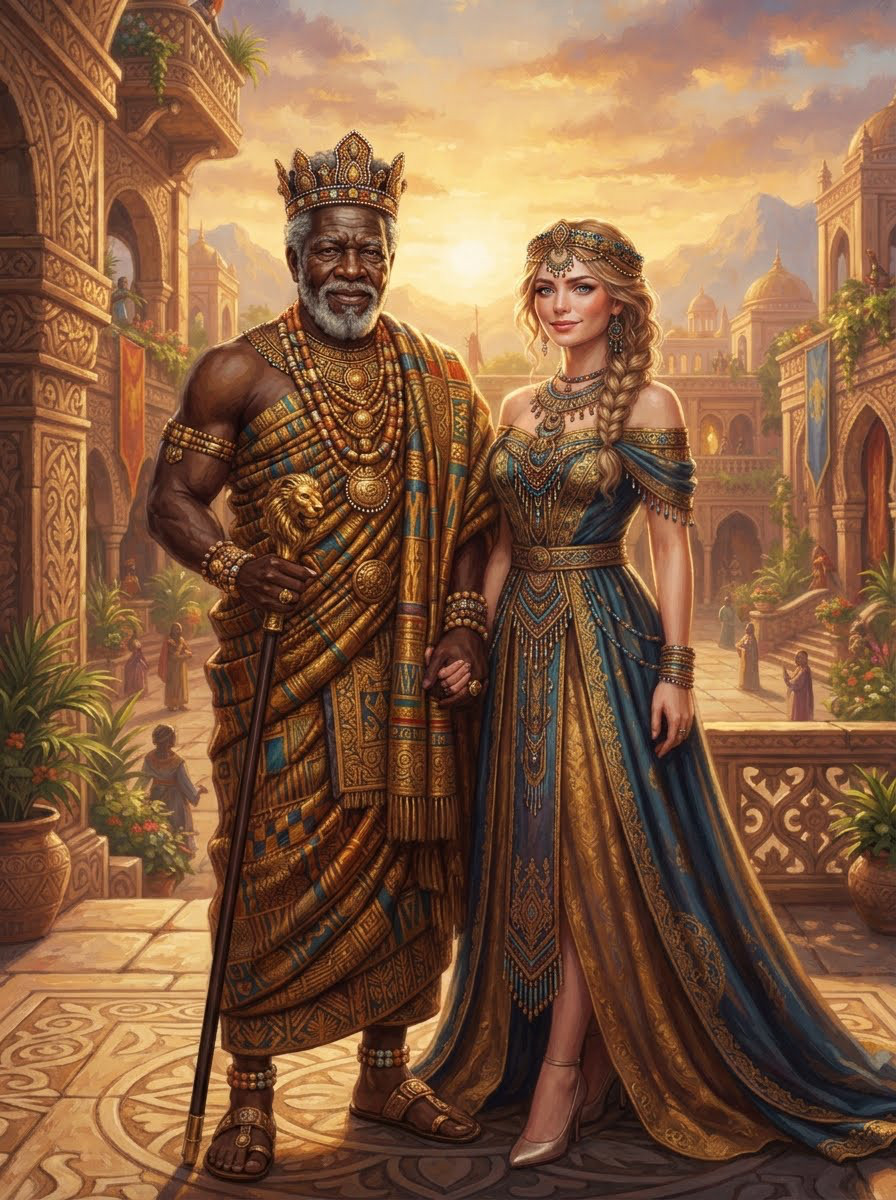
Crash Survivor Seduced by Maasai Chief
Chapter 1: Crash into the Chief's Eyes
The descent into Nairobi was supposed to be smooth. Jill had flown this route a dozen times for fashion shoots, for nature documentaries, for the glossy magazine spreads that paid her bills. Her camera bag was tucked beneath the seat in front of her, lenses wrapped in microfiber cloths, memory cards blank and waiting. Beside her, Daniel was complaining about the turbulence.
“It’s just thermals,” she said, not looking up from the viewfinder of her backup body. She was checking the light meter, watching how the sun slanted through the acrylic window. Golden hour was three hours away. They’d land, meet the fixer, drive to the reserve, and she’d have her opening shots before dusk.
Daniel shifted in his seat. He was an architect, not a traveler. His hands were too clean, his clothes too ironed. “Thermals don’t make the wings bounce like that.”
She finally looked at him. Daniel’s jaw was tight, his fingers white-knuckled on the armrest. She reached over and covered his hand with her own. “Hey. We’re fine. The pilot’s been flying this route since before we were born.”
“That’s not as comforting as you think it is.”
She laughed, a small sound that got swallowed by the drone of the engines. The plane was a Cessna 208 Caravan, twelve seats, most of them empty. Their fellow passengers were three photographers from a wildlife magazine, asleep in the back with their heads lolling against the windows, and a quiet man in a dark suit who had not spoken since takeoff from Addis Ababa.
Jill leaned back and closed her eyes. The hum of the engine was a lullaby. She let herself drift, half-dreaming of acacia trees and elephants, of the way light turned to honey on the savanna. Daniel’s hand relaxed under hers, and for a moment, everything was exactly as it should be.
Then the engine coughed.
It was a small sound, barely audible over the air vents, but Jill’s eyes snapped open. She had spent enough time in small planes to know the difference between the normal rattle of a turbo prop and something wrong. The pilot, a burly South African named Piet, turned in his seat. His voice came through the intercom, crackling and too calm.
“Folks, we’re experiencing a minor mechanical issue. Nothing to worry about. We’re going to begin a gradual descent and look for a place to set down.”
Daniel sat bolt upright. “What does that mean? Set down where? We’re over the middle of nowhere.”
“He said it’s minor,” Jill said, but her hand was already reaching for her camera bag, not to save the equipment but to hold onto something solid. The plane dipped, and her stomach rose into her throat. The engine sputtered again, a wet, choking sound, and then it went silent.
The silence was worse than the noise.
The propeller still spun, driven by the wind, but the power was gone. The plane became a glider, a metal bird with a broken heart, and the ground below was not flat. It was green and broken, rolling hills covered in dense vegetation, punctuated by rocky outcroppings and the occasional flash of a river.
“Brace positions,” Piet said, and this time his voice was not calm. It was tight, clipped, professional in the way that people sound when they are trying very hard not to scream.
Jill bent forward, pressing her chest to her thighs, her hands over the back of her head. Daniel did the same beside her, and she could hear him whispering something, a prayer maybe, or her name. The plane hit the first tree, and the sound was tremendous, a tearing of metal and wood that went through her bones. The second impact spun them sideways, and the third stopped everything.
Jill’s world went black, and for a long time, she was nowhere at all.
She woke to pain.
It was in her left shoulder, a deep, grinding ache that pulsed with every heartbeat. Her face was wet, and when she touched it, her fingers came away red. She was still in her seat, but the seat was no longer upright. It had been torn loose from the floor and thrown sideways, and she was lying on her side, her head against what used to be a window. The window was gone, replaced by a jagged hole ringed with green leaves and brown branches.
The smell was awful. Aviation fuel, smoke, and something else, something metallic and warm. Jill tried to move, and her shoulder screamed. She bit her lip and rolled onto her back, and that was when she saw Daniel.
He was still in his seat, but the seat was crushed. A tree branch the size of a man’s leg had come through the fuselage and pinned him against the floor, and his face was turned toward her, his eyes open and empty. His mouth was slightly open, as if he had been about to say something, and his chest was not moving.
“No,” she whispered. “No, no, no.”
She crawled toward him, dragging her left arm, the pain in her shoulder a distant roar behind the wall of adrenaline. She reached him and pressed her fingers to his neck, waiting for a pulse she already knew was not there. His skin was cool, and she sat back on her heels, her body shaking, her mind refusing to accept what her senses were telling her.
Daniel was gone.
The man in the dark suit was gone too, his body thrown clear of the wreckage. The three photographers were still strapped in their seats, but they were not moving, and Jill did not check them for pulses. She could see the angle of one of their necks, and she knew.
The pilot was slumped over the controls, his back twisted in a way that backs do not twist. The cockpit windshield was gone, and the wind came through, carrying the sound of birds and the rustle of leaves, sounds that belonged to a world that did not know what had happened here.
Jill crawled out of the wreckage through a tear in the fuselage, dragging herself over twisted metal and broken glass. The ground was soft beneath her, carpeted with ferns and fallen leaves, and she collapsed just beyond the wreckage, her face pressed into the earth. The smell of fuel was stronger here, and she knew she needed to move, needed to get away before the whole thing went up, but her legs would not obey.
She lay there for a long time, listening to her own ragged breathing, to the thrum of insects and the distant call of a bird she could not name. Her shoulder throbbed with every heartbeat, and her head spun when she tried to lift it. She thought of her mother, who had never wanted her to take this job. She thought of Daniel’s hands, which would never hold hers again. She thought of the camera bag, still under the seat, and for a moment, she thought about going back for it, but the scent of fuel made the thought feel like a death wish.
Instead, she pushed herself up onto her knees, then onto her feet, swaying like a sapling in the wind. She took one step, then another, putting distance between herself and the wreckage, between herself and the dead. The forest swallowed her, and the light began to fade, and Jill walked.
Time bent. The trees became a green tunnel, the ground a soft carpet of moss and rot. Her left arm hung useless at her side, and her right hand pressed against her ribs, where something sharp and broken moved beneath the skin. She stumbled over roots and through spider webs, her breath coming in short, sharp gasps that never quite filled her lungs. The sun had sunk low, and the shadows were long, purple and cold.
Then she heard voices.
They were not speaking English, and they were not speaking any language she recognized. The voices were deep, melodic, and they came to her through the trees, carried on the wind. Jill opened her mouth to call out, but the sound that came out was a rasp, a broken thing that would not carry. She tried again, and this time, a word emerged.
“Help.”
The voices stopped. The forest went quiet, and then there was movement in the underbrush, and shapes emerged from the shadows.
They were men, tall and dark-skinned, wearing animal hides and beads. Their bodies were lean, their faces painted with white and red ochre, and they carried spears. The points of the spears were long and wickedly sharp, and they were all pointed at her.
Jill raised her good hand, palm out. “Please,” she said. “Please, I need help.”
The men looked at each other, and then one of them, the tallest, stepped forward. He had a necklace of what looked like teeth around his neck, and his eyes were dark and unreadable. He studied her for a long moment, taking in the blood on her face, the way she swayed on her feet, the useless arm at her side.
Then he lowered his spear.
He said something to the others, a rapid string of syllables that Jill could not parse, and two of them moved toward her. She flinched, but they did not hurt her. One of them took her good arm and draped it over his shoulders, and the other moved to her other side, supporting her weight as her legs finally gave out. They lifted her as easily as if she weighed nothing, and then they were moving, carrying her through the trees.
The village was not far. It appeared through the trees like something from a dream, a cluster of round huts with thatched roofs, arranged in a circle around a central fire. The fire was already lit, and the flames cast dancing shadows on the faces of the people who gathered to watch her arrival. Women and children, old men and young warriors, all of them watching as the two men carried her into the circle and laid her gently on a woven mat beside the fire.
Jill’s vision swam. The fire blurred into a smear of orange and gold, and the faces around her became a sea of eyes, all of them fixed on her. She tried to speak, to thank them, but the words would not come. Her throat was dry, her mouth full of copper, and her body was so heavy, so terribly heavy.
Hands touched her. They were gentle, careful. A woman’s face appeared above her, old and weathered, with deep-set eyes and a mouth that moved in a chant or a prayer. The woman’s hands moved over Jill’s body, not in a sexual way, but with the sure, precise touch of a healer. She probed the injured shoulder, and Jill screamed.
The sound cut through the night, and for a moment, the whole village went still. Then the woman made a soft clucking sound and reached for a clay pot. She scooped out a paste of something green and pungent and began to rub it into Jill’s shoulder. The pain receded, replaced by a cool, tingling numbness that spread through her arm and up her neck.
Jill closed her eyes, and for the first time since the crash, she let herself rest.
The fever came in the night.
Jill woke in the dark, burning. Her skin was slick with sweat, and her head pounded like a drum, a relentless, tribal rhythm that seemed to come from outside and inside all at once. She thrashed on the mat, her limbs tangling in the rough blanket that had been laid over her, and voices rose around her, urgent and unfamiliar.
The old woman was there again, pressing a cool cloth to her forehead, forcing bitter liquid between her cracked lips. Jill swallowed, coughed, swallowed again. The liquid burned going down, but the fever receded, and she fell back into darkness.
The next time she woke, it was morning, and the light was soft and grey through the gaps in the hut’s thatched walls. She was lying on a low bed, a wooden frame strung with leather thongs, and the blanket that covered her was dyed a deep indigo with patterns she did not recognize. Her left arm was bound against her body with strips of cloth, and her ribs were wrapped tightly, but the pain was a dull ache now, not the sharp, jagged thing it had been.
She turned her head, and the world turned with her, but only for a moment. The hut was small, circular, with a packed dirt floor and a roof of woven grass. The walls were hung with animal skins and woven baskets, and in the corner, a small fire burned in a clay hearth, filling the space with the scent of smoke and something else, something floral and clean.
A woman was sitting beside the fire, watching her.
She was young, maybe twenty, with a shaved head and high, prominent cheekbones. Her neck was wrapped in coils of brass that stretched it to an impossible length, and her ears were stretched too, heavy with wooden plugs. She wore a wrap of bright kente cloth around her chest and a skirt of layered beads that clicked softly when she moved. She was beautiful.
“You are awake,” the woman said, and her voice was soft, accented but clear. “I am Amara. I have been watching over you.”
Jill tried to sit up, and the room spun. Amara was at her side in an instant, pressing her back down with a gentle hand on her chest. “Do not move. The fever has broken, but you are still weak. The healer says you must rest.”
“Where am I?” Jill’s voice was a croak, barely audible.
“You are in the village of the Maasai. The warriors found you in the forest, near the wreckage of your flying machine. They brought you here to be healed.”
“The others?”
Amara’s face softened with a sadness that needed no translation. “You were the only one who walked out of the forest.”
Jill closed her eyes, and the tears came. They leaked from beneath her lashes and ran down her temples into her hair. Daniel. The pilot. The three photographers. All of them gone. And she was here, in a place she did not know, surrounded by strangers who spoke with the voices of the forest and looked at her with eyes that held both pity and something else, something she could not name.
She cried until she could not cry anymore, and Amara stayed with her the whole time, her hand a warm weight on Jill’s arm, her presence a steady anchor in a world that had come apart. When the tears finally ran dry, Jill slept again, and this time, she did not dream.
The days that followed were a blur of healing and learning. The village was not large, perhaps two hundred people, and they moved through their days with a rhythm that felt both ancient and alive. The men hunted and tended the cattle, the women cooked and cared for the children and built the huts, and everyone, it seemed, had a role. Jill watched from her bed, then from the doorway of the hut, then from a low stool beside the fire, as the fever left her and her strength returned.
Her left arm was still weak, the shoulder slow to heal, but the healer, whose name was Nali, changed the poultice twice a day and made her drink a tea of bitter roots that made her muscles loosen and her mind go soft. Amara was her constant companion, translating the Maasai words into English, teaching Jill the names of things—fire is enkima, water is enkare, the moon is olapa—and laughing gently at Jill’s attempts to pronounce the words.
“Your tongue is too stiff,” Amara said, showing her how to click the sounds. “You must let the word come from deep in your throat.”
Jill tried, and the sound that came out made Amara laugh, a bright, musical sound that drew the attention of the other women. They smiled at Jill, and some of them brought her gifts—a gourd of milk, a string of beads, a piece of fruit she did not recognize. She had never felt so strange and so welcomed in her life.
The chief’s name was Ole Koinet, and he was not what Jill expected.
He was old, yes, with a face like cracked earth and eyes that held the wisdom of a thousand seasons. But he was also strong, his body lean and muscled beneath the red shuka he wore draped over one shoulder. His earlobes hung in long loops, stretched by years of heavy plugs, and his chest was crossed by rows of beaded necklaces, each one a marker of status, of battles won, of years lived well.
He came to see her on the third day, while she was sitting outside Amara’s hut, watching the children chase each other around the central fire. He stood over her for a long moment, his shadow falling across her face, and Jill looked up into his eyes and felt something shift inside her chest.
He was not handsome in the way that Daniel had been handsome. There was nothing soft about him, nothing polished. His features were heavy, his head was shaved smooth and gleaming in the afternoon sun, and his eyes were so dark they looked like holes into another world. But there was a power in the way he stood, a stillness that drew the air out of the space around them, and Jill found she could not look away.
“You are the woman from the sky,” he said, and his voice was a low rumble, like thunder far away. He spoke English slowly, carefully, as if tasting each word before he let it go. “Nali tells me you are healing well.”
“Yes,” Jill said. “I am. Thank you. Your people have been very kind to me.”
“Kindness is the first duty of a host,” Ole Koinet said. He lowered himself onto the ground beside her, moving with an ease that belied his age. The children stopped their game and gathered at a distance, watching with wide eyes. “But you are also a guest who fell from the sky, and the sky does not give up its people without a reason. Perhaps you are a sign.”
“A sign of what?”
He turned to look at her, and his eyes moved over her face, taking in every detail as if memorizing it. “I do not know,” he said. “But I intend to find out.”
Then he reached out and took her hand, his fingers rough and warm, and Jill felt a jolt go through her like a spark jumping between two points. He turned her hand over, studying the lines on her palm, the calluses on her fingertips, the place where her ring finger was bare. His thumb traced a slow circle in the center of her palm, and the touch was so intimate, so unexpectedly tender, that Jill forgot to breathe.
“Your hands are the hands of a maker,” he said. “A creator of images. The women of my village weave baskets and bead necklaces. The men carve spears and shields. But you make images that hold the soul of a moment forever. That is a rare magic.”
“I’m a photographer,” Jill said, and her voice came out breathless. She was acutely aware of the warmth of his hand, the way his eyes had not left her face. “I take pictures.”
“Pictures,” he repeated, as if the word was new to him. “And were there pictures in your flying machine? Pictures of the world you came from?”
“Yes. My camera bag. It was under the seat.”
Ole Koinet nodded slowly. “The warriors found such a bag. They did not know what it was. They brought it to me.” He released her hand, and the loss of his touch left a cold space that made her shiver. “When you are well enough, you will show me this magic of yours.”
He stood, and the children scattered like leaves in the wind. “Rest now,” he said. “Grow strong. The village is yours, and you are safe here.” He paused, and for a moment, his gaze dropped to her mouth. It was only a flicker, so brief she almost missed it, but the heat that followed it was real, and it settled low in her belly and stayed there long after he had gone.
Jill sat there for a long time, her hand still tingling where he had touched her. She thought about Daniel, about his cool skin and empty eyes, about the weight of his hand in hers on the plane. The grief was still there, a stone in her chest, but there was something else too, something that felt like the first green shoot pushing up through burned earth.
She should not be feeling it. She knew that. But her body did not listen, and neither did the part of her mind that had begun, quietly, to notice the way the chief moved, the way the muscles in his shoulders shifted beneath his shuka, the way his eyes burned like coals in the firelight.
That night, she woke in the dark to the sound of drums.
The rhythm was slow at first, a heartbeat in the earth, and it grew louder, more insistent, until it was everywhere. Jill sat up in her bed, her heart pounding in time, and through the gaps in the hut walls, she could see the fire blazing in the center of the village. Figures moved around it, their shadows long and dancing, and the air was thick with singing, a deep, resonant chant that rose and fell like breathing.
Amara appeared in the doorway, her face alight with excitement. “Come,” she said. “There is a celebration. A warrior has returned from his initiation in the forest. The whole village is gathered.”
Jill hesitated, but the drums pulled at her, and she followed Amara out into the night. The fire was enormous, taller than the tallest man, and the heat pressed against her skin like a living thing. The villagers had formed a circle around the flames, and in the center, a young man danced alone, his body painted with white clay, a lion’s mane draped over his shoulders. He leapt and spun, his movements sharp and powerful, and the drums matched him beat for beat.
Jill stood at the edge of the circle, and the heat of the fire and the pulse of the drums and the sweat on the bodies around her made her feel dizzy. She was aware of her own skin, of the places where the fabric of her borrowed clothes—now a simple Maasai wrap, tied at her shoulder—touched her. Her left shoulder was still wrapped, but the rest of her was bare, and the night air was warm and alive.
Then she saw him.
Ole Koinet was standing across the circle, his face painted with red ochre in sweeping lines that ran from his temples down to his jaw. He was wearing a lion-skin headdress, and his chest was bare except for the beads, and his body was something out of a myth. He was watching her, and the firelight made his eyes glow, and the distance between them felt like a string pulled tight, vibrating with every beat of the drums.
He did not move toward her. He did not need to. The moment stretched, and the dancing went on, and the drums grew louder, and Jill felt the heat building inside her, a slow burn that started in her chest and spread outward, through her limbs, into her fingertips, into the place between her thighs that had been silent since the crash. It was not grief. It was not loneliness. It was something older, something that had been waiting beneath the surface, and it woke now under his gaze like a wild thing scenting the wind.
Amara leaned close, her voice a whisper in Jill’s ear. “The chief watches you,” she said. “He has not looked away since you came into the light.”
Jill swallowed. “Why?”
Amara smiled, a slow, knowing smile. “Because he has seen something in you,” she said. “And the chief sees many things that others do not.” She paused, and then she added, almost teasingly, “It is not wise to ignore the attention of the chief. It is a great honor.”
The dance ended, and the fire cracked and spat, sending sparks spiraling into the dark. The villagers dispersed, laughing and talking, but the chief did not move. He stood on the other side of the fire, his eyes still on Jill, and she found herself rooted to the spot, unable to look away, unable to take a step toward him, unable to take a step back.
Then he turned and walked into the shadows, and the string that had been stretched between them snapped, and Jill let out a breath she had not known she was holding. Her body was trembling, and her skin was hot, and she knew, with a certainty that frightened her, that something had begun.
She did not know what it was. She did not know where it would lead. But she knew, as she followed Amara back to the hut and lay down on the rough bed, that sleep would not come easily that night. The drums were silent now, but her blood still beat with their rhythm, and behind her closed eyes, all she could see was the chief’s painted face, the fire in his eyes, and the promise that burned there, unspoken but undeniable.
She pressed her thighs together beneath the thin blanket, and the ache between them was sharp and sweet, and she thought, Not yet. Not yet. But soon.
And in the darkness of the hut, as the village slept and the fire died down to embers, Jill finally understood that she was no longer the woman who had boarded that plane. She was something else now, something shaped by fire and blood and the weight of a chief’s gaze, and she had no idea who she would be when the sun came up.
0 comments
No comments yet
The story has no discussion yet. Leave a note here when a branch gives you something to say.
No chapter comments yet
No one has commented on this branch yet. Add the first note above.