Fireside Confessions
Stories as Confessions
There are nights when six people may leave the ordinary world behind them without going very far.
No need to cross an ocean, climb a mountain or crawl into a magical wardrobe. Sometimes it is enough to drive two hours west through the darkening roads of the Midwest, past the last gas station until the pavement turns to gravel and the cornfields swallow the world.
And then, if they are lucky, they come to a farmhouse.
The farmhouse was not beautiful in the way of the paintings that people hang in their kitchens. It was beautiful in the older and more useful way. It had been built for the ideal American family of two and a half kids—no mudrooms, lofts, man caves, just an open floor plan and four bedrooms. Its boards were weathered. Its windows were small. The porch leaned slightly toward the woods, as though the whole house had spent too many years listening to the forest and had finally begun to bend toward it.
Beyond the farmhouse there were trees, and beyond the trees, cornfields, and beyond those the long darkness of the Midwestern countryside.
The six had come here for one night without their children.
This was the important thing.
Not the bourbon. Not the cabin. Not the fire.
That the children were somewhere else.
For one night there would be no lunch to pack, no school spirit day, no soccer practice, no dance rehearsal, no school email marked URGENT that was not urgent, no little voice calling from another room at five in the morning, no argument over screens, showers, homework, vegetables, bedtimes, or whose turn it was to feed the dog.
There would only be the six of them.
They had been friends long enough to remember one another before marriage, before mortgages, before children, before the accumulation of the little possessions and obligations that eventually come to look like a life. They knew one another’s houses and birthdays and college majors. They had attended weddings and funerals together. They had stood beside hospital beds and carried boxes during moves. They had watched one another become older.
And yet there were things they did not know.
There are always things people do not know.
Ross and Rachel arrived first.
Ross had driven, naturally.
Ross drove almost everything in his life.
He was the sort of man who had opinions about steering wheels and watches and the correct thickness of athletic socks. He was forty, though he had spent the last years attempting to make forty appear to be thirty-five, and the years before that attempting to make thirty-five appear to be twenty-eight. His body was the great project of his life. He lifted weights. He ran. He measured things. He counted things. He had once calculated the number of calories in a restaurant meal while eating it and had somehow considered this evidence of discipline rather than pathology.
He was handsome, certainly.
He had the handsome, polished appearance of a man who had begun to regard his own face as a business asset.
His hair was always right. His clothes were always fitted. His teeth were unnaturally white. Even his casual clothing seemed to have been arranged by someone whose job was making rich men look as though they had never tried to look rich.
He had made his money in business and spoke of that business with the restrained confidence of a man who had discovered, early in life, that almost every problem could be improved by hiring somebody else to solve it.
Rachel came behind him carrying two bags.
Rachel was the sort of woman other women looked at and then looked away from. They use the words “too pretty” as an insult.
She was beautiful in the almost painful way that beauty can become when it has been maintained too carefully. Her strawberry-red hair fell across her shoulders with an effortlessness that required considerably more effort than anyone was permitted to know about. Her skin was smooth and freckled. Her body was slender. Her clothes were expensive without announcing themselves as expensive.
There were hints, if one knew where to look, of the small corrections that wealth permits and insecurity encourages.
A little too much fullness in her lips.
Too little movement in the forehead.
The unnatural size of her bust on her thin frame.
And the eyes.
The eyes had remained beyond the reach of money.
They were blue, and beautiful, and there was something in them that did not belong with the rest of her face. Something tired. Something disappointed. Something that had once expected more.
Rachel was a stay-at-home mother, which sounded to some people like leisure and to others like imprisonment, depending upon what they believed about women and money and the meaning of work. She had everything that could be photographed. A beautiful house. Beautiful children. A beautiful husband. Vacations. A kitchen with marble countertops. Clothes that fit. Skin that glowed.
And still, sometimes, she would stand alone in the bathroom after everyone had gone to bed and stare into the mirror for a long time.
She never knew exactly what she was looking for.
Ross knew she did this.
He had never asked her why.
There were certain questions married people learned not to ask.
There were also certain questions they learned to answer with bourbon.
Chandler and Monica came next.
Chandler was blonde, broad-shouldered, and strong in the unremarkable way of a man who had spent his life doing physical things because somebody had to do them. He worked with his hands. He did not complain about work. He did not talk much about himself.
Chandler had become the kind of man who could spend an entire evening agreeing with everyone.
He was not weak.
This distinction mattered to him, though he would never have said so.
He could lift heavy things. He could repair things. He could endure discomfort. If a tire blew out in the rain at midnight, Chandler would be the man everyone wanted beside them.
But he had a peculiar relationship with decision-making.
He could make decisions for other people easily enough.
For himself, not so much.
He had learned somewhere along the road that life became simpler if you let somebody else decide what happened next.
Monica, on the other hand, had never permitted anybody else to decide anything.
She was a registered nurse, which suited her because nursing gave her a world full of problems that had solutions and people who required competence. She was organized. She was practical. She made lists and remembered birthdays and knew where the spare batteries were. If civilization collapsed tomorrow, Monica would be the person who had already purchased bottled water and labeled the boxes.
She was brunette and attractive, though she did not seem to know—or did not care—that she was attractive.
She had curves that other women would have displayed and men would have noticed, but Monica dressed as though her body just needed to be protected from the elements, not something to be presented to the world.
She loved Chandler.
At least she believed she did.
And Chandler loved Monica.
At least he believed he did.
Marriage had done something strange to them.
It had not destroyed them.
That would have been simpler.
Instead it had made them efficient.
They had become good at living together.
Good at groceries. Good at bills. Good at children. Good at schedules. Good at knowing who would pick up whom and when.
They were good at marriage.
They were not always sure whether they were still good at being married.
Joey and Phoebe arrived last.
Nobody heard them coming.
Then suddenly there they were, as they tended to be.
Joey emerged from the darkness carrying a cooler in one hand and laughing at something that nobody else had heard. He was a large man, a very large man, with the heavy shoulders and thick arms of somebody who had spent his life being mistaken for a dangerous person, and he wasn’t one to relieve them of their delusion.
He had a beard.
The beard was enormous.
It was not a beard that grew on a man’s face so much as a beard that had established residency.
Joey was loud. Joey was always loud.
Even when he whispered, he seemed to be announcing something.
He had the gift, or curse, of making himself the center of any room. He interrupted. He exaggerated. He told stories that took twice as long as they needed to. He laughed at his own jokes and sometimes at jokes that were not jokes. If you didn’t hear him talk about the size of his penis in the first ten minutes, you weren’t paying attention.
His friends occasionally found him annoying.
They loved him anyway.
He was the man who could turn a flat tire into an adventure, a missed flight into a story, a bad restaurant into an evening they would remember for ten years.
He made things fun.
Phoebe made them dangerous.
She was tiny beside Joey, half Japanese, tattooed, dark-haired, and possessed an energy that seemed physically incapable of remaining inside her body. She moved quickly. She spoke quickly. Her expressions arrived before her words.
She had the strange beauty of a woman who had never once considered whether she was behaving properly.
Where Joey entered a room like a marching band, Phoebe entered like a lit match.
Together they were exhausting.
Together they were wonderful.
There are couples who calm one another.
Joey and Phoebe did not.
They amplified one another.
When they were around, there was a party.
And on this particular night, they had come prepared to make one.
They gathered around the fire.
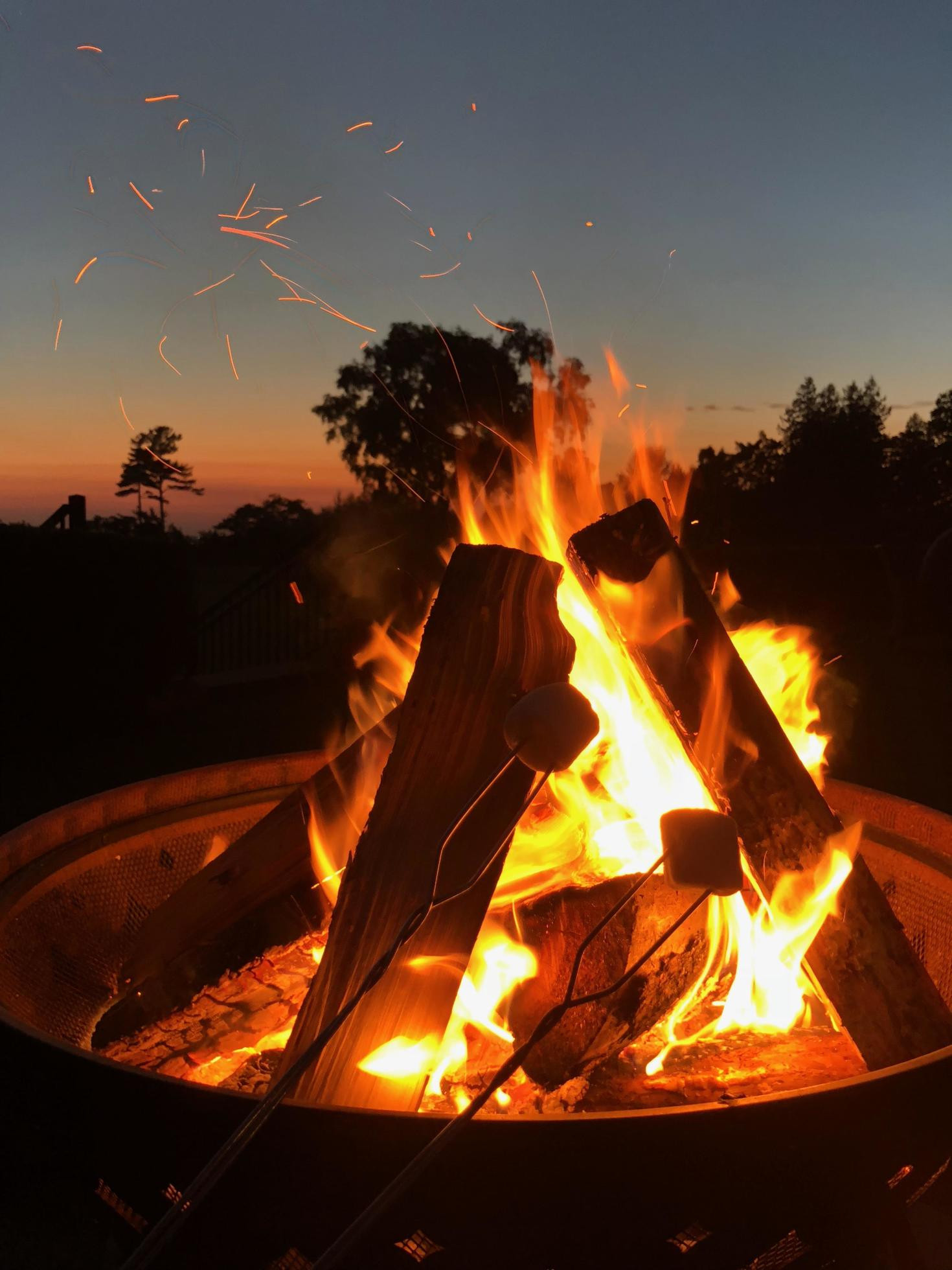
The fire had been burning for some time, and by now the logs had collapsed inward, glowing red beneath their blackened surfaces. Sparks rose occasionally into the cold air and vanished. The woods stood around them in all directions, immense and silent, while the six people sat in a circle of light that seemed too small to contain them.
Their phones were nearby.
Nobody touched them.
This was perhaps the strangest thing of all.
The bourbon came out.
Ross had brought it.
Of course he had.
It was expensive bourbon in a bottle whose shape suggested that somebody had spent as much time designing the bottle as they had making the whiskey. Ross poured carefully, even though nobody was watching.
They raised their glasses.
To the night.
To being away.
To the children sleeping somewhere else.
To not having to be responsible for anyone but themselves.
They drank.
The bourbon burned down their throats and warmed their stomachs and, for a brief moment, gave each of them the illusion that they had become simpler people.
The fire snapped.
Joey leaned back.
Phoebe tucked her legs beneath herself.
Monica stared into the flames.
Chandler watched the others.
Rachel watched Ross.
Ross watched his bourbon.
And for a while nobody spoke.
It was an old silence, older than all six of them, older than their marriages and their houses and their children’s schools and their smartphones and their careers and their carefully constructed lives.
It was the silence in which people once sat around fires because there was nothing else to do.
And then Joey smiled.
Someone—though afterward none of them could agree who—said they should tell stories.
Not jokes.
Stories.
Real stories.
Something that had happened.
Something embarrassing.
Something funny.
Something terrible.
Something nobody else knew.
The suggestion hung in the air.
They looked at one another.
Because everyone knew, even then, what stories really were.
Stories were the things people told when they wanted to confess without admitting they were confessing.
Stories were doors.
And every one of the six had a door.
Some had locked theirs.
Some had only pulled it shut.
Some had been standing behind theirs for years, waiting for somebody to knock.
The bourbon was poured again.
The fire burned lower.
The woods listened.
And somewhere in the circle, six married people sat beneath the dark Midwestern sky, each carrying a story that might have changed everything if it had been told at the right time.
No one yet knew who would speak first.
0 comments
No comments yet
The story has no discussion yet. Leave a note here when a branch gives you something to say.
No chapter comments yet
No one has commented on this branch yet. Add the first note above.